The Angola Project
Written 2026-02-05
Back in January of 2023, the start of my second semester of college, I wasn't yet a computer science major. When I originally went to college, I'd had a passion for linguistics and anthropology in general, which stemmed from my experience making conlangs (constructed languages) as a hobby throughout middle and high school. My college didn't have much of a linguistics program, so I leaned into the broader field of anthropology, originally taking some introductory archaeology classes.
When January came around, it came time for my first ISP. My school was an honor's college, and something that we did a bit differently was that the entire month of January was an "interim" term- basically its own mini-semester- where, rather than having classes, we had an independent study project that we would work on. Imagine something like an honor's thesis project, but smaller scope- something that could be done in a month. The subject of the project would either be determined by the student (and they'd get a professor to sponsor it) or they'd join in on a recurring project that a professor might host every January. Students were required to complete 3 of these ISPs before getting their degree, and only one of them had to be related to your major. Since I was still undecided between anthropology, computer science, and creative writing, I went with an anthropology/archaeology ISP hosted by my professor/academic advisor, Uzi Baram.
For this ISP, I got to join in on the Angola Project. I had a lot of fun working on this project, and I'm still fairly passionate about the topic. I even made a kind of website/digital paper talking about the project and the linguistic work I did for it, and I wanted to preserve what I did here on my own website.
On Angola
Around 2008, my professor started an archaeological dig of the community of Angola in and around Sarasota and Bradenton, Florida. Here is a picture of the site during the digging process:
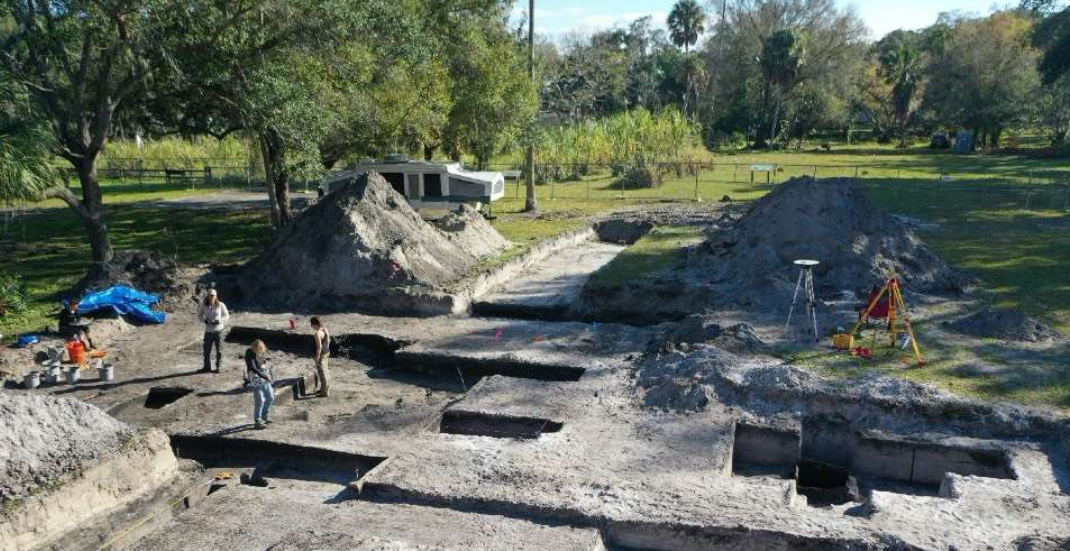
Angola was a community of maroons (formerly enslaved, freedom-seeking peoples) that settled on the Manatee River. Florida, being a Spanish territory, was a significant route on the underground railroad at the time due to Spain's outlawing of slavery in 1811. At its peak, from 1812 to 1821, Angola was inhabited by over 700 people, but ended up being destroyed as the United States acquired and then expanded into Florida. As a result, Angola's inhabitants were forced to flee. Some fled to the British Bahamas (specifically the town of Red Bays on Andros Island), while others hid deep in the Florida Everglades, living among the growing Seminole tribe. All of the other inhabitants were likely killed or enslaved.
For this project, I focused on cultural interpretation, specifically by looking into the languages spoken by the maroons that lived in the original community. I chose this topic not only because of my interest in linguistics, but also because I feel that langauge is one of the most effective ways of representing and recording culture. Language is a tool that allows members of a given group to communicate with each other, and the things that this group considers important enough to reflect in their language can give crucial insights into their daily lives, as well as the influences of other cultures upon their own.
Afro-Seminole Creole
The Argument
There are many different proposals for what the common language among Angola's community would have been. There was a large quantity of British goods found at the site, implying trade with the British, as well as the fact that many of those who successfully fled the community were able to find asylum within the British Bahamas- some of these people were even recorded to have fought alongside the British in the War of 1812, or had served as British colonial marines. For these reasons, it makes sense that English is generally thought to have been the lingua-franca among Angola's community.
However, during my research into this community and its descendants, I began to think this might not be the full story. Many Africans throughout the United States at the time spoke varieties of pidgin and creole languages that, while being influenced by West African languages, maintained a degree of mutual intelligibility with English. These languages still persist in the modern day- for example, with Sea Islands Creole, also known as Gullah or Gullah Geechee. Many of the maroons living in the Angola community were likely familiar with these creole languages before first fleeing to Florida, and if the maroons had in fact spoken an English creole (similar to Gullah) they could have still been understood well enough by the British to facilitate trade and cultural exchange- especially considering that the British were likely familiar with similar creole languages spoken throughout their island territories.
Since, in the areas around the Angola community, there was a growing Seminole (Maskókî and Mikisúkî language) presence, as well as the fact that some of the maroons who fled the destruction of Angola managed to integrate into the surrounding Seminole communities in the Everglades, it is not unlikely that whatever English creole the maroons spoke could have been influenced by these languages.
One such creole language does, in fact, exist, and I hypothesize that this language was (at least, very closely related) to what was spoken by the peoples of Angola.
The Language
This language is Afro-Seminole Creole (hereby referred to as ASC).
ASC is related to Gullah, sharing a majority of the same vocabulary. Both languages include many words with origins from West African languages, alongside many English terms. However, it appears that Gullah has a significantly larger body of West African terms, likely due to the influx of people from what is now Sierra Leone and other nearby regions, which happened after the people who would become ASC speakers fled to Florida. Because of this, as well as ASC's later borrowings of Maskókî and Mikisúkî words, and Spanish words even later, these two creole languages diverged.
These two creole languages, in the modern day, are even more different from each other, likely due to Gullah's persistence in a more metropolitan environment, resulting in more anglicized (English-y) grammar and vocabulary structures. From all this information, I can illustrate a rough diagram of ASC's hypothetical "family tree", showing how these two creoles diverged from a common ancestor dialect:
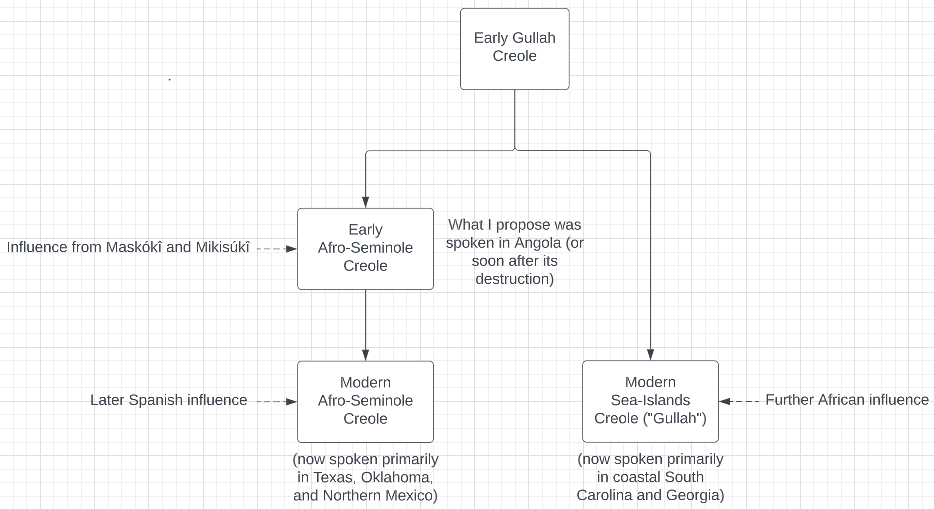
I think that it's possible that the earlier form of ASC in the tree could have been the language of the people of the Angola community.
Heritage Interpretation
As a product of my research, I used grammar and vocabulary documents provided personally by Dr. Ian Hancock to construct a vocabulary list of terms for significant things or concepts to the people that lived in Angola, according to what was found in the archaeological digs. The list is obviously imperfect, as there are terms we simply don't know and others that may have been used or pronounced differently in their time, but I hope that this serves as a good jumping-off point for future research, as well as being a provocative artifact of the daily lives of these freedom-seekers.
In the original version of this vocabulary list, I included IPA characters for pronunciation as well as voice recordings of me saying the words, but as time's passed I've grown increasingly unsure of the accuracy of my pronunciations, so I've excluded them here so as to not be overly speculative. The documents Dr. Ian Hancock gave me regarding ASC did not record pronunciation, so by excluding them I'm being as faithful to the research as possible.
Words for Animals
We'll start with a brief list of words for animals. We know a little bit about what animals (domestic or otherwise) were commonly found in the community from the zooarchaeology work done at the site. All of the following animals had been present in Angola:
| ASC Word    | Meaning                                          |
|-------------|--------------------------------------------------|
| 'ooman cow  | A female cow, literally a "woman cow"            |
| biddy-biddy | A chicken, especially a small variety of chicken |
| booboo      | A bug, an insect                                 |
| buyd        | A bird                                           |
| cootee      | A pig                                            |
| cootuh      | A turtle                                         |
| cyahf       | A calf                                           |
| dog         | A dog                                            |
| gonneh      | A rat                                            |
| hen         | A hen, female chicken                            |
| hoss        | A horse                                          |
| john-crow   | A buzzard                                        |
| lissut      | A lizard                                         |
| mahn cow    | A bull, literally a "man cow"                    |
| rahbit      | A rabbit                                         |
| rockoon     | A raccoon                                        |
| rustuh      | A rooster, male chicken                          |
| tuckrey     | A turkey                                         |
Words for People
These words reflect the demographics of the community, as well as the surrounding areas. It's also where many of the words from Seminole languages are present in ASC:
| ASC Word   | Meaning                                                         |
|------------|-----------------------------------------------------------------|
| 'ooman     | A woman, also used as an adjective ("female")                   |
| buckra     | A non-Seminole person (black or white, but not Mexican)         |
| istichatti | Native American (Indian)                                        |
| istilachi  | A black person                                                  |
| mahn       | A man, also used as an adjective ("male")                       |
| panish     | Spanish                                                         |
| shiminolee | Seminole, maroon (ASC speakers often refer to themselves and    |
|            |   their language as "Seminole")                                 |
| tustanagga | A warrior-leader                                                |
Words for Food, Crops, and Agriculture
We know a bit about the types of food that was grown in the community, both from analyzing non-native plants that have thrived in the area after being introduced by the people of Angola as well as through archaeological evidence:
| ASC Word  | Meaning                                                          |
|-----------|------------------------------------------------------------------|
| brade     | Bread, tortilla                                                  |
| cone      | Corn                                                             |
| cone-cake | Cornbread, literally "corn cake"                                 |
| coob      | A chicken coop                                                   |
| coonteh   | Arrowroot (originally, now used to refer to a type of palm used  |
|           |   to make flour)                                                 |
| coosh     | Cornmeal dough                                                   |
| crap      | Crop/crops                                                       |
| cunky     | Tamale (steamed cornmeal dough rolled with ground meat)          |
| feely     | Coarse and dry cornmeal                                          |
| flawa     | Flour                                                            |
| grahss    | Grass                                                            |
| gyahlic   | Garlic                                                           |
| nyamnyam  | Food                                                             |
| ponkin    | Pumpkin                                                          |
| suffki    | A cornmeal porridge                                              |
| talluh    | Tallow, suet                                                     |
| tettuh    | Potato                                                           |
| yubb      | An herb                                                          |
Everyday Objects and Daily Life
Finally, from artifacts found at the archaeological site, we have some other words regarding everyday things- buildings, household objects, and other aspects of material and immaterial culture:
| ASC Word              | Meaning                                              |
|-----------------------|------------------------------------------------------|
| 'poon                 | A spoon                                              |
| assy (or bluck jrink) | The "Black Drink", a highly caffenated narcotic      |
|                       |   drink made with yaupon berries used in Creek       |
|                       |   ceremonies                                         |
| cunjuh                | A magical charm                                      |
| fote                  | A fort                                               |
| gombuh                | A drum                                               |
| hoodoo                | Magic spells (you may be familiar with "Voodoo")     |
| huckle                | An adobe hut                                         |
| kittle                | A kettle, a cauldron                                 |
| pingih                | A cooking pot                                        |
| pipe                  | A tobacco pipe                                       |
| tabby                 | Tabby, a material used throughout Florida made from  |
|                       |   lime, sand, and shells; similar to concrete        |
| tabby-house           | A house made from tabby                              |
| teemuh                | To dig                                               |
| zundu                 | Hammer (the tool or the action of using it)          |
Conclusions and Future Goals
I put in a lot of work after the fact to preserve what I did for this project. According to my professor, there's very little linguistic research into Afro-Seminole Creole, and the work that I did for this project (including the incredibly short set of sources that I used) essentially make up the complete body of knowledge relating this language to the Angola community and communities like it. Copying my work onto my blog is just one way that I have attempted to keep this work around- although I've made sure that all of my original work was passed onto my professor for future students to work on.
I'm not as involved in this project as I was when I first joined in January of 2023- at the time I was still pursuing a degree in anthropology, and since then I've transitioned to (and, as of January 2026, completed) my degree in computer science. I still have a passion for anthropology, archaeology, and linguistics in particular, so I hope to maybe rejoin the efforts related to the Angola Project someday.
Sources
- The Afro-Seminole Creole Language Revitalization Project, provided by Dr. Ian Hancock.
- Mascogo: Texas Afro-Seminole Creole, provided by Dr. Ian Hancock.
- Black Seminoles: The Gullah Connections by Alcione M. Amos from The Black Scholar.
- Recovering History by the Manatee Mineral Spring written by Diane Wallman and prepared by Uzi Baram.
- Cosmopolitan Meanings of Old Spanish Fields by Uzi Baram.